
How to Cook Perfect Steamed Japanese Rice (A Monk's Guide)
- Eiten

- Dec 2, 2025
- 2 min read

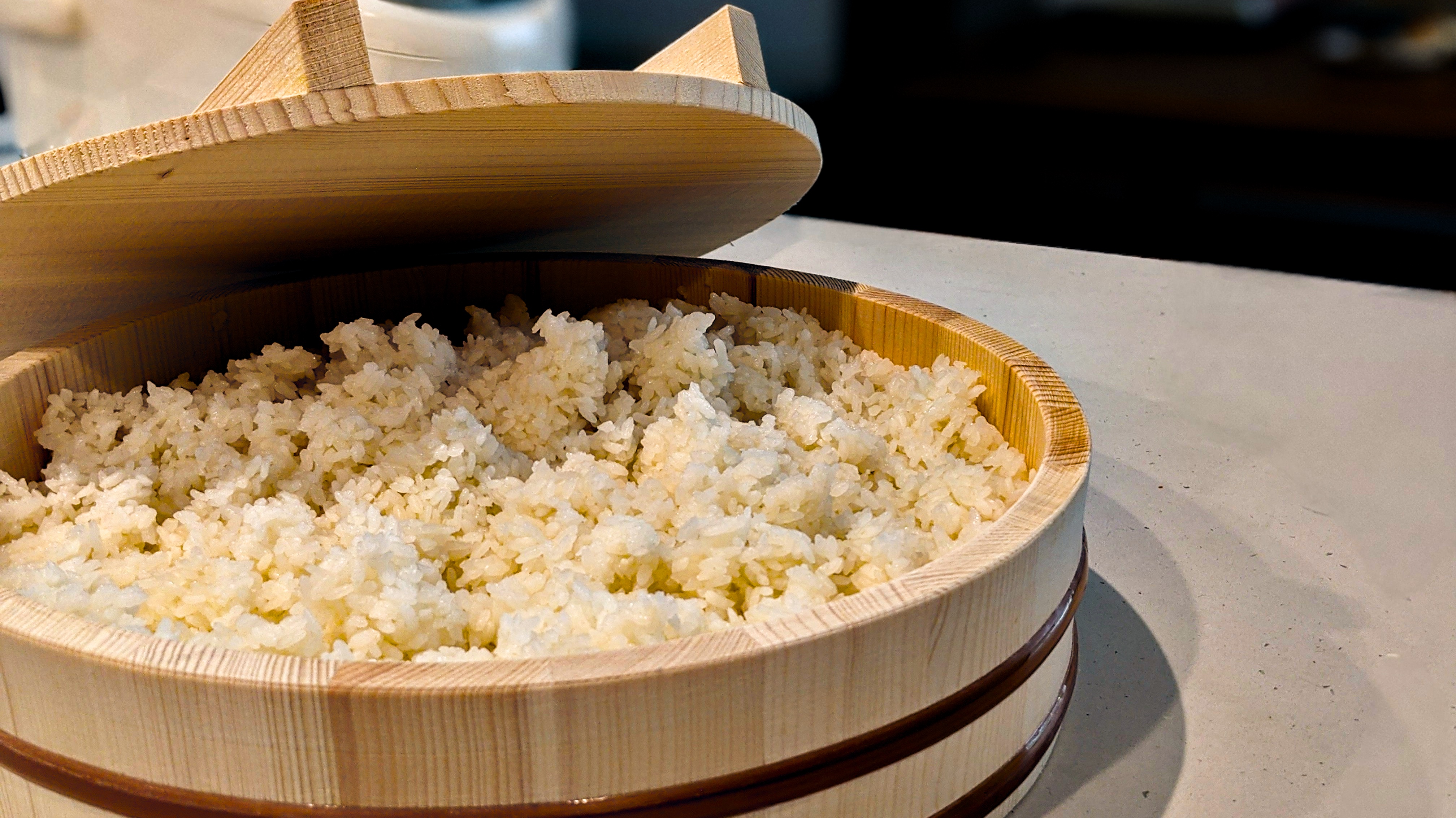
Steamed Japanese Rice in a Traditional Cedar Bucket (Ohitsu) © 2025 Tenzo's Kitchen LLC
In the West, rice is often treated as an afterthought—a filler side dish to support the "main event." But in Shōjin Ryōri (Japanese Buddhist temple cuisine), rice is the foundation. It is the canvas upon which the meal is painted.
When I was training on Mt. Hiei, each meal was centered around a bowl of steamed Japanese rice: porridge in the early morning (okayu) served with ground sesame and salt (goma-shio), and a bowl of perfectly cooked unadorned grains at noon. Pickles on the side with both meals, and a separate side dish of vegetables at noon, but it was all secondary to the rice.
Today, I am sharing the professional method I use to make steamed Japanese rice that is fluffy, distinct, and perfectly textured. The secret lies not in an expensive rice cooker, but in a simple, mathematical ratio: 1.35.
Why “The Ratio” Matters
Many home cooks struggle with rice that is either too mushy or undercooked in the center. This usually happens because we rely on the "knuckle method" or inconsistent cup measurements.
To solve this, we use a digital scale.
For Japanese short-grain rice, the "Golden Ratio" I use in Tenzo's Kitchen is 1:1.35.
1 part Rice (by weight)
1.35 parts Water (by weight)
For example, if you have 400g of rice, you multiply that by 1.35 to get 540g of water. This precision removes the guesswork and delivers consistent results every single time.
The Ritual of Washing (Mindfulness in Action)
The step that separates good rice from great rice is how you wash it.
Washing the rice washes away the "dust of the world," and the dust remaining from when the rice was harvested and polished! Practically speaking, you are removing excess starch that makes the rice gummy and can cloud the aroma and flavor of the grains.
Place your rice in the bowl and add water.
Gently swirl your hand in a "claw" shape. Do not crush the grains; be gentle, as if you are polishing a stone.
Drain the cloudy water.
Repeat 3-4 times until the water runs mostly clear.
Chef’s Tip: Don’t strive for crystal clear water—a little starch helps the grains hold together, which is essential if you plan to eat with chopsticks.
Soaking is Essential to Perfectly Steamed Japanese Rice
If you have ever had rice that was hard in the middle but soft on the outside, you likely were eating rice that was not properly soaked.
Japanese short-grain rice is plump and dense. It needs time for the water to penetrate the core of the kernel before the heat is applied. I recommend soaking your rice after adding the measured water for 30 to 60 minutes before hitting the "start" button.
This simple act of patience ensures the rice cooks evenly from the inside out.
1
Storage
If you are batch cooking for the week or just made a little too much, you can weigh the rice into portions, wrap the portions individually, and freeze for up the 1 month. Gently warm the rice in a microwave for a few minutes to get it hot.
Notes


1
WEIGH THE RICE. Place your rice cooker insert on a scale and tare it to zero. Add your desired amount of rice. (In my video, I use 400g).
2
WASH THE RICE. Cover with water, swirl gently, and press down with your open palm several times to rub the grains against one another. This motion helps to "polish" the grains and dislodge any dust and starch clinging to the grains. Drain and repeat. Do this 3-4 times until the water is relatively clear.
3
SOAK THE RICE. After the final wash, use a strainer to drain the rice well. Let the rice drain in the strainer for about 10 minutes to remove as much water as possible. Return the insert to the scale, tare the scale, and add the rice to the insert. The weight will have increased from water absorption. This is normal. Use a calculator to multiply the starting weight of the rice by 1.35. Add that weight to the original starting weight, and that is your target weight for both the rice and cooking water. Just add fresh water until you reach the total target weight. For example, to cook 400 grams of rice you need 540 grams of water, or 940 grams total weight. Let it soak for 30 minutes to 1 hour.
4
COOK THE RICE. Place the pot in your rice cooker and set to the manufacturer's recommended mode. If you have a basic model, you are in luck: likely you only have an on/off switch, so you just need to turn it on. My model has more functions and settings, but I always use the Quick Mode (30 minute cook time).
5
FLUFF THE RICE (Shari-kiri). When the timer goes off, open the lid immediately. Use a wet paddle (shamoji) to cut through the rice and gently fold it over. Rotating the insert as you do this helps ensure you don't miss a spot. This releases excess moisture and prevents the rice from clumping into a solid block. You can hold the rice in the cooker to keep it warm at this point, or serve immediately.
Instructions
400 grams Short grain Japanese rice
540 grams Water
Steamed Japanese Rice
Eiten

Servings :
10 x 120 grams
Calories:
140 (approx.)
Prep Time
10 min
Active Cook Time
30 min
Passive Cook Time
30 min
Total Time
1 hr 10 min


Comments