
Piadina: Flatbread from Emilia-Romagna
- Eiten

- Nov 18, 2025
- 2 min read
Updated: Nov 20, 2025
Years ago when I worked as Marco Canora's sous chef at Hearth Restaurant in Manhattan's East Village, he used to always speak about the similarities between Italian and Japanese cuisines. It took me decades of kitchen work and an arduous journey up to the top of a certain mountain in Shiga to discover just how right he was.
This simple 5-ingredient recipe for Piadina—the traditional Emilia-Romagna flatbread—is the first recipe in a new series exploring how traditional Italian cooking naturally aligns with the fundamental principles of shōjin ryōri:
☆ Seasonality (shun・旬)
☆ Harmony with the environment (shin-do-fu-ji・身土不二)
☆ No-waste (ichibutsu zentai・一物全体).
You don't have to cook traditional Japanese shōjin ryōri recipes to embrace the principles behind the practice. In fact, the principles are universal truths that have been practiced by ancient cultures for millenia, allowing them to reap the benefits they hold for body, mind, and spirit.

What is Piadina? The Italian Flatbread Nobody is Talking About
Piadina (also called piada) is an unleavened flatbread from Italy's Emilia-Romagna region, particularly associated with the area around Rimini on the Adriatic coast. Historically, it was peasant food—the bread of people who couldn't afford or access yeast, or who needed something quick between the demands of farmwork.
The traditional recipe is almost austere in its simplicity: soft wheat flour, lard (or olive oil in some coastal areas), water, and salt. Some recipes—like this one—include a small amount of baking soda for slight leavening, but many skip even that. The dough is rolled thin, cooked quickly on a terracotta griddle called a testo (now usually cast iron), and served warm, either as an accompaniment to the meal or stuffed with a variety of fillings and enjoyed as a complete meal on its own.
What makes piadina significant isn't technical complexity—it's the opposite. This is bread reduced to its essence, shaped by economic necessity and regional availability. The people of Romagna created something that transcended its humble origins to become a defining element of their food culture.
That transformation from necessity to tradition, from scarcity to sufficiency, runs parallel to the philosophy underlying shōjin ryōri: taking what is available seasonally within a time and place and realizing its full potential.
1
Storage
This recipe is quite easy, and is best enjoyed straight from the pan. If you make a large batch and want to save some to eat later, you can wrap it in plastic wrap then foil and freeze it for up to one month. To reheat, simply allow the flatbreads to come to room temperature (min. 30 minutes), then sprinkle with a bit of water and warm for up to a minute on each side in a warm pan set over medium heat.
Notes


1
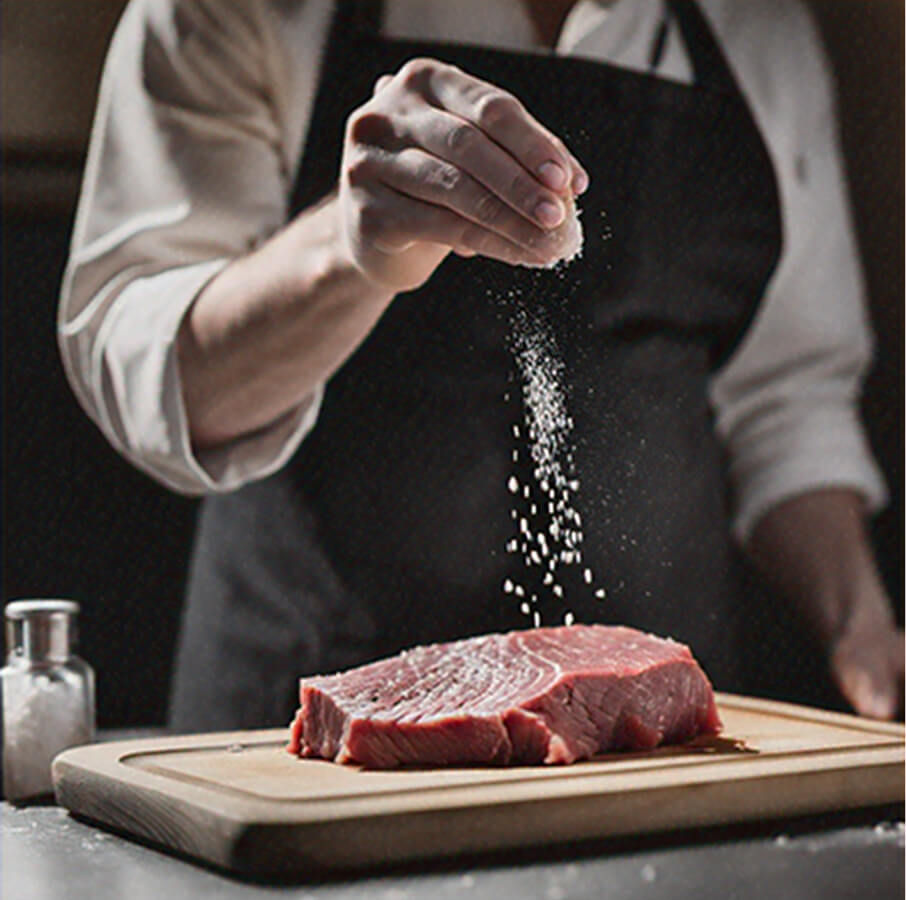
MAKING THE DOUGH. Put the flour, salt, and baking soda in a bowl. Add the olive oil and use your fingers to work it in. Keep mixing until you have a crumbly dough resembling sand. Pour in the water and stir to combine into a rough dough ball. Knead the ball until the surface is smooth. About 3-4 minutes. Cover the bowl with a clean kitchen towel or plastic wrap and allow to rest for 30 minutes.
2
PORTIONING THE DOUGH. Transfer the dough to a cutting board, and cut into four equal pieces. About 110 grams each. Cup the dough loosely in the palm of your hand, and work in a circular counter-clockwise motion to shape each piece into a smooth ball.
3
ROLLING THE PIADINA. Use a rolling pin to roll each ball into a flat round disk, approximately 1/4" thick. The shape doesn't have to be perfect, but take care to roll it so that the thickness is uniform to ensure that it cooks evenly.
4
COOKING THE PIADINA. Set a dry pan over medium heat. When hot, lay in one of the flatbreads. Cook until dough expands and air bubbles appear. This takes about 2 minutes or so. Check the underside of the dough. It should be evenly cooked with charred spots dotting the surface. Flip the dough and cook on the other side for an additional 2 minutes. Repeat until all of the flatbreads are cooked.
Instructions
250 grams AP Flour
3 grams Sea salt
1.5 grams Baking soda
45 grams Olive oil
120 grams Water
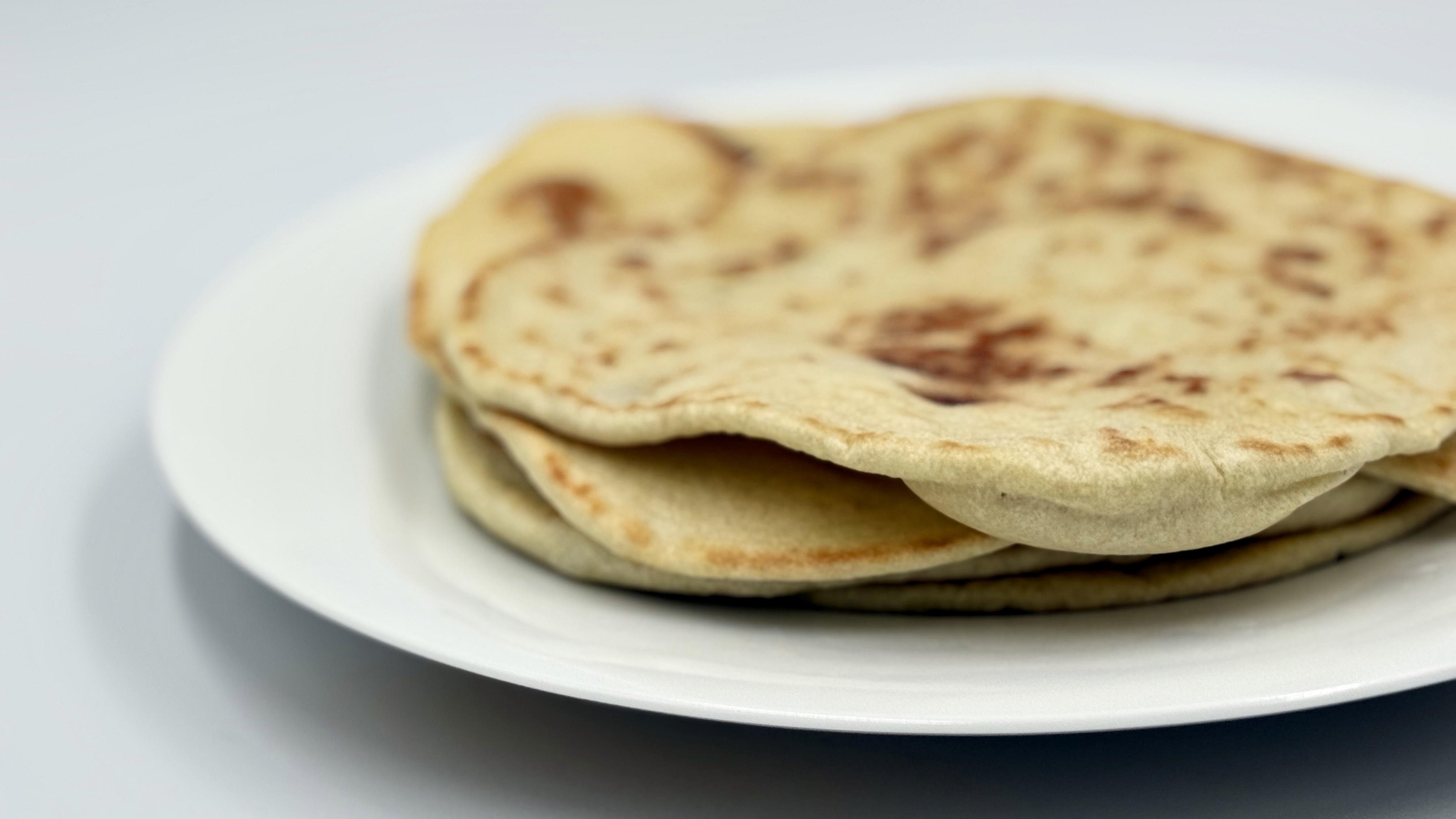
Italian Shōjin Series: Piadina Flatbread from Italy's Emilia-Romagna
Eiten

This traditional version uses olive oil instead of lard, making it accessible for plant-based eating while honoring the essential character of the original. It's the kind of recipe that proves you don't need complexity to create something deeply satisfying.
Servings :
4
Calories:
About 250-300
Prep Time
10 min
Active Cook Time
15 min
Passive Cook Time
30 min
Total Time
55 min


Comments